
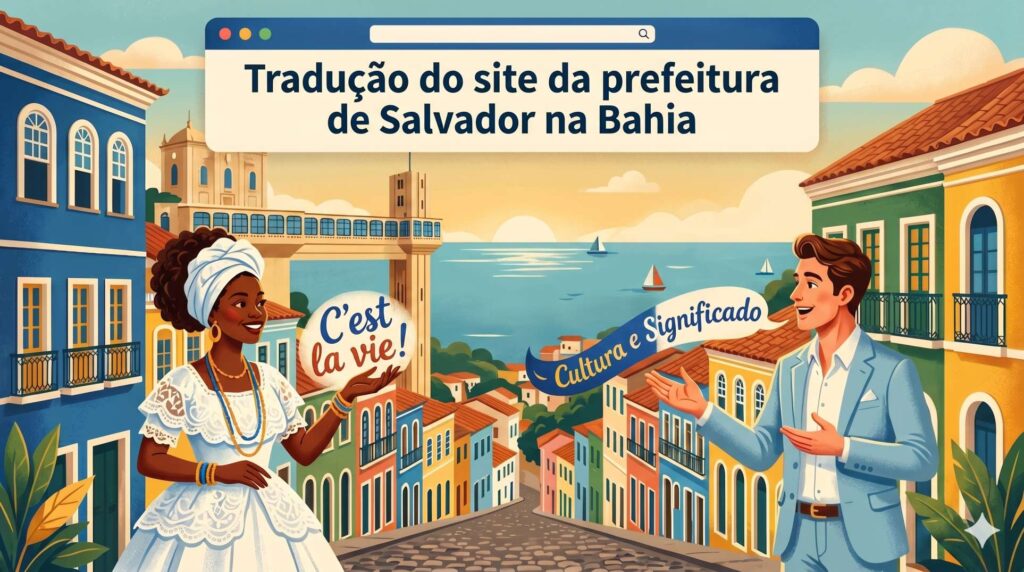
Salvador, Bahia, in French: The Content Engineering Behind a Success Story in the European Market
The internationalization of institutional tourism portals requires an approach that goes far beyond simply translating words from one dictionary to another. When the destination in question is one of the most culturally rich capitals on the planet, the challenge becomes a complex exercise in linguistic anthropology and corporate precision. Success Story
In this article, we detail our translation company’s success story in the cultural localization into French of the official tourism portal for Salvador (Salvador da Bahia). This channel, strategically managed by the City of Salvador, serves as the primary digital gateway for European travelers.
Below, we’ll see how our team of senior linguists overcame severe language barriers. The goal was to ensure that the French-speaking audience accurately understood Bahia’s uniqueness, while preserving the prestige and magic of Brazil’s first capital.
The salvadordabahia.com Portal and the Urgency of Prestigious Global Communication
Salvador’s official tourism portal is the digital showcase of a city that breathes history, music, and syncretism. With the increase in the flow of high-end European travelers, the City of Salvador identified the need to make this content available in French, serving crucial source markets such as France, Belgium, Switzerland, and Canada.
The decision to create a fully French-language version was based on the behavior of French-speaking tourists, who are globally recognized for their deep interest in historical, heritage, and cultural immersion tourism. To attract this discerning audience, the website required impeccable linguistic presentation.
Our agency was selected to take on this critical linguistic infrastructure, tasked with replacing flawed automated translation systems with high-quality human translation. The project was designed from day one to establish itself as a market benchmark.
The Challenge of Translating Salvador’s Identity and Culture for a French-Speaking Audience
How do you translate the rhythm of Olodum, the devotion of the Baianas de Receptivo, or the warmth of an afternoon at the Farol da Barra? The biggest hurdle wasn’t French grammar, but the vast cultural gap between a Parisian and a Salvadoran.
Bahian culture is composed of deeply local terms that have no exact equivalents in any other language. A literal translation of these elements results in a complete loss of historical meaning, generating confusing texts that undermine the portal’s institutional authority.
Our team of localization specialists focused on finding the perfect balance between technical accuracy and reading fluency. It was essential that the French reader deeply understand the meaning of each tradition, feeling invited to experience the real Bahia firsthand.
Success Story in Practice: Real Examples of Localization and Cultural Sensitivity
To demonstrate the technical complexity and cultural sensitivity applied to the project, we divided our work into three major pillars of the city’s identity. Each term listed below underwent an internal linguistic validation committee review to ensure its effectiveness in the European market.
Traditional Bahian Cuisine
Salvador’s cuisine is an intangible heritage inseparable from the tourist experience. Converting it into generic French names would be a strategic mistake in terms of brand launch and positioning.
Acarajé: Instead of translating it as a simplistic “beignet de haricots” (bean fritter), we kept the original term in italics and added a sophisticated sensory culinary description: “an Afro-Brazilian culinary specialty made from cornmeal batter fried in palm oil (dendê), topped with shrimp.”
Dendê Oil: Precisely defined as “crude palm oil (dendê),” immediately distinguishing it from the refined palm oil used in the European food industry, highlighting its artisanal properties and cultural value.
Moqueca: Presented to the French public as a “traditional fish or seafood stew, slowly cooked in coconut milk and dendê oil,” sparking the culinary interest of haute cuisine.
Historical Expressions and Popular Festivals
Salvador’s major street celebrations and historic sites required sophisticated conceptual equivalents so that foreign audiences could grasp the scale and organization of these events.
Lavagem do Bonfim: Translated and contextualized as “The festival of the purification (Lavagem) of the steps of the Bonfim Church,” explaining in detail the ecumenical ritual and the role of the baianas in the procession.
Pelourinho: The proper name was retained, but systematically accompanied by the inseparable term “le quartier historique du Pelourinho,” immediately reminding the reader of the concept of UNESCO World Heritage.
Trio Elétrico: We avoided absurd literal translations such as “electric truck.” The solution adopted was “monumental mobile stage (Trio Elétrico) on which artists perform during Carnival.”
Religiosity and Bodily Expressions
Religious syncretism and the arts that blend sport and dance demanded the utmost ethical and anthropological rigor from our translators.
Candomblé: Defined with institutional respect as an “ancestral Afro-Brazilian religion of Yoruba origin,” avoiding any pejorative or reductionist terms common in automatic translation platforms.
Capoeira: Correctly classified as an “Afro-Brazilian martial art that combines dance, music, and acrobatics,” preserving its status as a sport and a form of cultural resistance.
High-Performance Linguistic Methodology and Glossary Engineering
The delivery of this major project was structured based on global best practices in corporate language management. We implemented a workflow consisting of native translators, reviewers specializing in luxury tourism, and a final quality control committee.
To maintain consistency across hundreds of pages and scripts on the official portal, we developed a proprietary translation memory. This technology prevents the same cultural term from being translated differently by various professionals, safeguarding the integrity of the Salvador brand.
The rigor applied to the portal’s data engineering ensured not only elegant text but also a stable platform ready to meet the demands of the European market. Navigation became intuitive for the user, respecting business etiquette and the information consumption patterns of French-speaking countries.
The Importance of Human and Professional Translation for the City’s International Image
Relying on free tools or translators without expertise in content localization is a reputational risk that major brands and public agencies cannot afford to take. A poorly executed translation creates confusion that can undermine the image of a premier tourist destination.
Professional human translation acts as a legal, commercial, and institutional safeguard. In the case of Salvador’s official tourism portal, the accuracy in describing tourist attractions, schedules, safety, and hotel infrastructure conveys immediate reliability to tourists when booking travel packages.
By opting for a high-quality translation and localization service, the City of Salvador has raised the bar for its international communication. The capital of Bahia has positioned itself digitally with the same elegance as major European capitals, showing cultural respect to visitors even before they board their flights.
Conclusion: A Model of Excellence in the Internationalization of Global Destinations
The internationalization of large-scale digital assets requires a vision that integrates technical rigor, anthropological sensitivity, and deep respect for local culture. The work developed for the portal clearly demonstrates how these factors build an indestructible global reputation.
This project has established itself as a true success story in our institutional history, proving that the language barrier ceases to be an obstacle when addressed with expertise, rigorous methodology, and a passion for the precision of words.
By speaking the language of its visitors with fluency, elegance, and cultural authority, Salvador opens its doors to the world with the prestige it deserves. Our agency is proud to have crafted the linguistic architecture that connects the soul of Bahia to the heart of the European public.
