

Text Translation, Localization, and Global Expansion: The Definitive Guide to Borderless Business
In the global business ecosystem, written communication is the foundation of every successful transaction. Whether adapting a complex digital ecosystem or translating technical engineering specifications, textual accuracy is what separates sustainable growth from an irreversible strategic error. Our Translation, Versioning, and Localization unit was designed to provide linguistic assurance and technical compliance for companies operating in highly demanding environments.
We offer a 100% online service model, which allows us to quickly serve clients in any city in Brazil and in corporate centers around the world. From São Paulo to the most remote industrial hubs, our digital reach ensures that geographical distance is never an obstacle to translation excellence.
1. Translation vs. Adaptation: The Engineering Behind Writing
For those seeking professional results, it is vital to understand that the direction of the text defines the technical expertise required of the linguist. Although common sense treats them as the same, the processes are distinct:
Translation (Direct Direction)
This is the process of transposing a text from a foreign language into our native language. The central goal is naturalness. The Brazilian reader, for example, should consume the content without realizing that it was conceived in another culture. This requires the translator to have a deep mastery of local grammatical norms and the stylistic subtleties that lend fluidity to the text.
Adaptation (Reverse Direction)
This involves conveying Brazilian ideas and data into a foreign language. Versioning requires the professional not only to know the target language but to have “lived” in the market for which they are writing. A poorly executed version can make a solid company appear amateurish abroad. That is why we focus on maintaining the original corporate tone of voice, adapting it so that it resonates with authority among an international audience.
2. Localization (L10n): Strategic Digital Adaptation
Simply translating a website does not guarantee its effectiveness abroad. The localization process is necessary, which follows the W3C’s global internationalization guidelines.
Localization means adapting variables that go far beyond words:
International SEO: We research how local users actually search for your product. We don’t just translate keywords; we map them following Google’s best practices for Multilingual Website Management.
Interface and User Experience (UX): We adjust layouts to accommodate different sentence lengths, as well as adapt date formats, currencies, units of measurement, and cultural symbols.
Brand Resonance: We ensure that the “appeal” of your marketing makes psychological sense to the target audience, respecting local values and customs.
3. Technical Translation and the Need for Human Curation
With the advancement of technology, automated tools have become ubiquitous. However, in sectors such as engineering, law, medicine, and information technology, automation alone poses a high operational risk.
Terminological accuracy is our greatest strength. Common errors in automated systems—such as the selection of inappropriate synonyms for industrial parts or legal terms—can invalidate manuals and contracts. Our methodology prioritizes human expertise: the text is handled by professionals who understand the actual context of the application, often adhering to rigorous international standards such as ISO 17100 for translation services.
4. Important Distinction: Technical Translation vs. Certified Translation
It is essential to clarify the types of services for the legal security of our clients:
Technical and General Translation: Focused on manuals, websites, corporate presentations, emails, and training materials. This is the service that drives the day-to-day operations of companies and where we hold our greatest expertise.
Certified Translation: Please note that we are not authorized to perform certified translations. This specific service, which lends public credibility to the document, must be performed exclusively by certified translators registered with the Commercial Registries. Our specialty lies in high-quality translation for commercial, technical, and institutional purposes.
5. An Ecosystem of Integrated Solutions
Translating documents and websites is just the starting point. When your company needs to bring the text into the realm of real-world interactions, our interpretation ecosystem kicks in:
Consecutive Interpretation: Ideal for closing negotiations based on the contracts we have just translated.
On-Site Interpretation: For field inspections where the translated technical documentation needs to be explained in practice.
Remote Interpretation via Zoom: For webinars and global meetings, using native audio tools that break down barriers in real time.
Frequently Asked Questions (FAQ)
How do I request a quote for website translation? Simply send us the URL or the content export file. We analyze the word count and technical complexity to provide a customized proposal that includes international SEO.
Do you serve companies outside major metropolitan areas? Yes. Our online service model is designed to cover the entire country and clients abroad. Delivery is digital, secure, and supported by continuous remote communication channels.
Is document confidentiality guaranteed? Absolutely. All projects are governed by non-disclosure agreements (NDAs), ensuring that your data and trade secrets are protected under the highest information security standards.
Our Recent Projects

Simultaneous or Consecutive Interpretation: Which Is Best for Your Event?
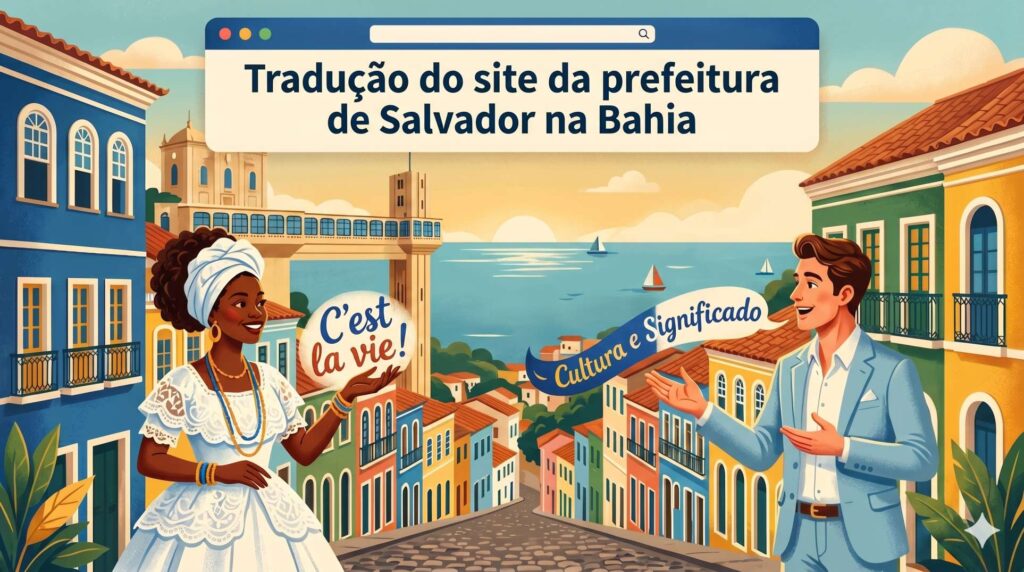
Success Story: How Translation and Cultural Localization Brought the Essence of Salvador to a French Audience

Gostei muito dos meus estudos. Embora meu progresso tenha sido lento demais para o meu gosto, as aulas individuais me ajudaram a desenvolver fluência na fala, expandir meu vocabulário e melhorar minhas habilidades de leitura. A compreensão auditiva continua sendo o aspecto mais desafiador. Obrigado.
Alain