
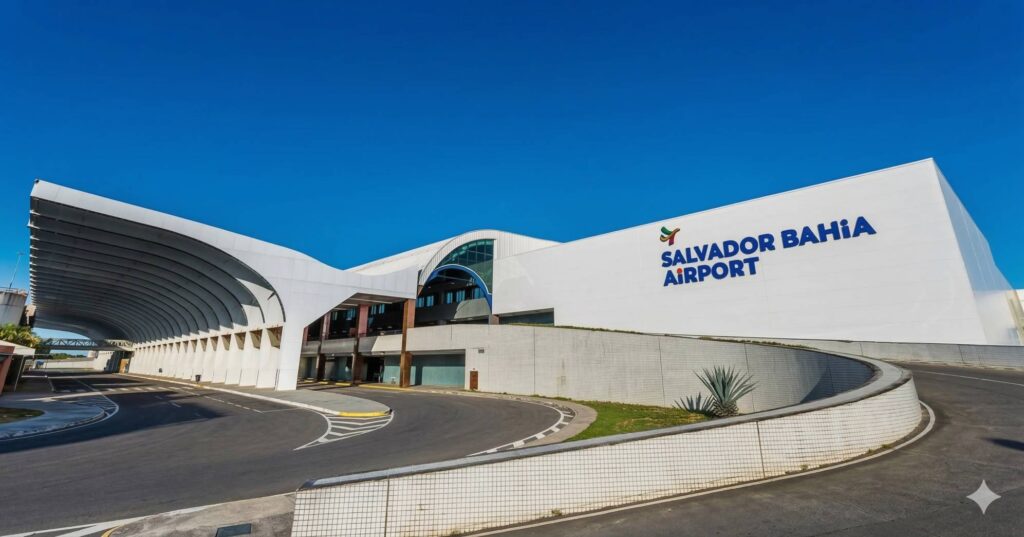
Experience & Insights: Technological Transition and Management by VINCI Airports at Salvador Airport
The acquisition of a critical infrastructure asset, such as an international airport, is one of the most complex logistical and communication challenges a corporation can face. When the French giant VINCI Airports secured the concession for Salvador Airport (Salvador Bahia Airport) in 2017, a transition process began that required surgical precision.
Our company was the key player in this process, operating at the intersection of French, English, and Portuguese, ensuring that European operational culture was successfully implemented on Brazilian soil.
1. The Global Context: Who is VINCI Airports?
To grasp the magnitude of this project, one must understand the client. VINCI Airports is the world’s leading private airport operator. Headquartered in France, it is part of the VINCI Group, a global player in concessions and construction.
By taking over Salvador Airport, VINCI wasn’t just buying a concession; it was exporting a management model focused on sustainability, technological innovation, and operational efficiency. Our mission was to ensure that nothing was lost in this “export of intelligence.”
2. The Transition Period: 2017–2018 and the Brazilian Context
The auction took place in March 2017, and the operational transition began shortly thereafter. It was a time of transition from a state-run model to a high-performance private model.
In this scenario, our technical interpretation and translation team was called upon to work on two fronts simultaneously:
The Technology Front: Installation of proprietary hardware and software.
The Administrative Front: Understanding internal office workflows and management processes.
3. Technical Interpretation: Installation of Proprietary Technology
VINCI Airports uses global monitoring, security, and passenger flow systems. The installation of this proprietary technology required our interpreters to work directly with systems engineers from France and IT specialists who used English as their technical working language.
IT and Airport Engineering Challenges
We work on translating protocols for:
Air Traffic Management Systems: Where terminological accuracy is a matter of national security.
Ground Logistics Software: Ensuring that the local team understood the new French efficiency metrics.
Cybersecurity Protocols: Adhering to international data protection and infrastructure standards.
4. Beyond the Machinery: Office Management and Cultural Onboarding
Many companies make the mistake of focusing solely on the machinery. VINCI Airports, with its long-term vision, knew it needed to understand the actual operations of the Salvador airport office.
Administrative Immersion
Our team spent weeks inside the executive offices and administrative departments. We helped the French team decipher:
HR Processes and Brazilian Legislation: Translating the nuances of labor law and local hiring practices.
Financial and Accounting Flows: Essential for integrating the airport into the parent company’s global balance sheet in France.
Organizational Culture: We acted as cultural mediators. The French management style—focused on rigorous processes and a clear hierarchy—needed to be communicated in a way that made the Bahian team feel engaged, not just commanded.
5. The Trilingual Ecosystem: French, English, and Portuguese
Although the company was French, the aviation industry speaks English. This project was a rare example of simultaneous trilingual interpretation.
Often, during the same board meeting, we had to switch between French (the language of the parent company), English (the technical language of aviation/IT), and Portuguese (the local operational language). Our ability to maintain fluency across these three fronts without losing the technical “thread” was what ensured that technology implementation deadlines were met.
6. The Importance of Terminological Accuracy in the Airport Sector
Translation errors at an airport don’t just cost money; they can cost operating licenses with ANAC (National Civil Aviation Agency).
During the VINCI transition, the integrity of the following was ensured:
Standard Operating Procedure (SOP) Manuals.
Concession Contracts and Legal Addenda.
Environmental and Infrastructure Audit Reports.
7. Cultural Mediation: The Strategic Edge
Helping VINCI “take charge” of the airport also meant serving as the company’s “ear” in Brazil. Reading between the lines of office conversations allowed French managers to make fine-tune adjustments to their leadership approach.
This interpretive support at the executive level is what we call Linguistic Diplomacy. It is not just about words; it is about fostering trust between the parties during a time of uncertainty (as is the case with any transition of ownership).
8. Transition Results: VINCI Airports’ Success in Salvador
The result of this integration orchestrated by VINCI Airports is visible and measurable. Thanks to the group’s strategic vision and the dedication of the Brazilian and French teams, Salvador Bahia Airport has established itself as one of the most efficient operations in the global network. Under VINCI’s management, the airport has achieved historic milestones, frequently being awarded the title of “Brazil’s Most Sustainable Airport.”
Language support served merely as a facilitator, enabling the company’s technical expertise to flow without barriers. This synergy allowed the client to achieve:
Efficiency in Technology Migration: VINCI’s IT team completed the implementation of its proprietary systems without operational delays, ensuring uninterrupted service for passengers from day one.
Cultural and Administrative Integration: Local managers and employees absorbed the group’s culture of excellence in record time, establishing clear communication between the Salvador office and the headquarters in France.
Alignment with the Global Vision: VINCI’s executive team successfully conveyed its values of innovation and sustainability, engaging the entire workforce in building a new standard for airports in the Northeast.
9. Why choose our expertise for international transitions?
The VINCI Airports case at Salvador Bahia Airport proves that we are prepared for the market’s greatest translation and interpretation challenges:
Online and In-Person Services: We serve clients anywhere in Brazil and abroad.
Specialized Human Curation: We do not rely on flawed automation for critical engineering and management terms.
Infrastructure Expertise: We are fluent in aviation, IT, and corporate management jargon.
Frequently Asked Questions (FAQ) – Corporate Transitions
What is the difference between French interpretation and technical translation in this case? French interpretation was used in real time during meetings and in the field. Technical translation focused on the documentation, manuals, and IT software that VINCI installed.
How do you manage confidentiality in infrastructure projects? We work under strict Non-Disclosure Agreements (NDAs). All strategic information regarding VINCI Airports and Salvador Airport was handled with the utmost security.
Do you serve other companies in the transportation sector? Yes, our localization and technical translation methodology is applicable to ports, railways, and major logistics hubs operating in multilingual environments.
