

Simultaneous Interpretation: The Art of Real-Time Communication
At the heart of major international conferences, diplomatic summits, and global launches, simultaneous interpretation is the method that ensures information flows without interruption. Unlike consecutive interpreting, there are no pauses here: the interpreter’s voice overlaps the speaker’s with a delay of just a few milliseconds (known as décalage), allowing hundreds of people to understand the message in their own languages simultaneously.
For projects of monumental scale—such as the integration of global supply chains, energy infrastructure partnerships, or innovation conferences—simultaneous interpretation is not just a convenience; it is the engine that enables global synchronization.
1. The Cognitive Engineering Behind Simultaneous Interpretation
Simultaneous interpretation is considered one of the most demanding and complex mental activities. The interpreter must perform three tasks simultaneously:
Listen and Analyze: Decode the technical message in the source language.
Convert: Find the exact cultural and terminological equivalents.
Speak: Produce the speech in the target language while maintaining the speaker’s tone and emotion.
Due to the high mental strain, interpreters always work in pairs, alternating every 20 or 30 minutes to ensure that terminological accuracy remains at 100% throughout the event.
2. Infrastructure and Technology: The "Booth"
To ensure flawless communication, simultaneous interpretation requires a rigorous technical setup, adhering to international standards such as ISO 2603 (for fixed booths) and ISO 4043 (for mobile booths).
The Conference Kit:
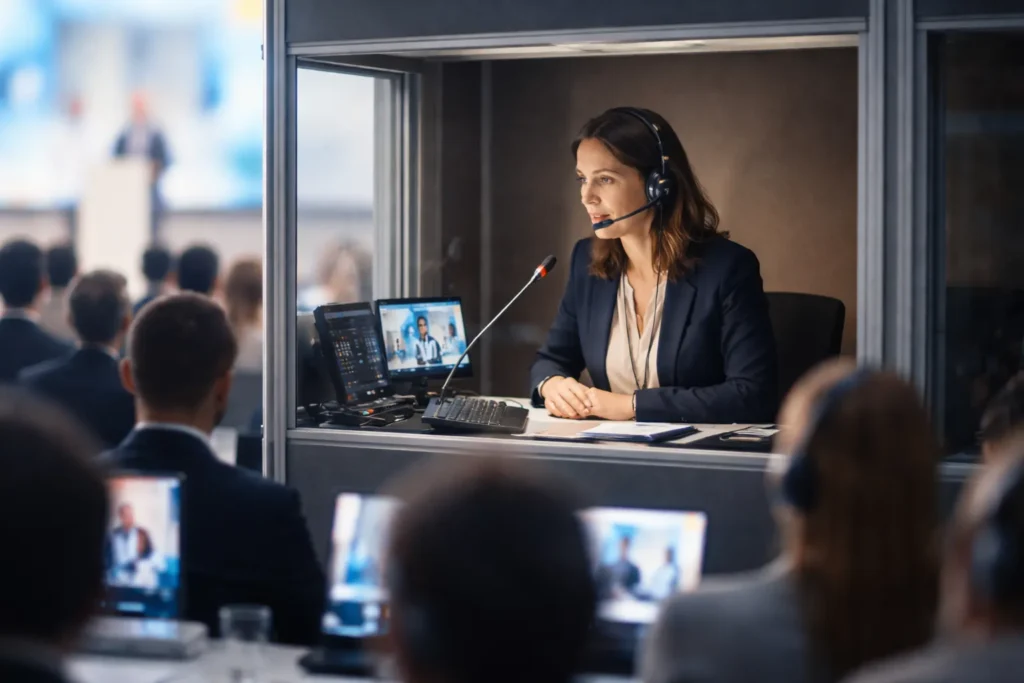
Soundproof Booths: These block out external noise so the interpreter can remain fully focused and their voice does not leak into the auditorium.
Interpreter Consoles: High-fidelity equipment used to control volume and switch channels.
Receivers and Headphones: Distributed to the audience, allowing each participant to select their language channel (e.g., Channel 1 – Portuguese, Channel 2 – English, Channel 3 – Spanish).
Transmitter Radios: Can use FM or Infrared technology (the latter is ideal for confidential meetings, as the signal does not penetrate the walls of the room).
3. Strategic and Geopolitical Applications
Simultaneous interpretation is the mandatory choice in scenarios where information density is high and time is the scarcest resource:
High-Tech and Defense Symposia
At conferences on aerospace cooperation and cybersecurity, where international experts discuss advanced engineering and the integration of complex systems, simultaneous interpretation allows for the transfer of knowledge to occur without interruptions. For large audiences of technicians, researchers, and officials, this method ensures the event runs smoothly, saving up to 50% of the time compared to consecutive interpretation.
Economic Summits and Foreign Trade
At intercontinental forums and meetings of economic blocs, simultaneous interpretation is vital for aligning trade policies, investment flows, and global supply chains. Accuracy regarding commodity trading, health protocols, and customs agreements is ensured by interpreters who master the technical vocabulary and diplomatic nuances necessary to maintain trust among nations.
Sector-Specific and Infrastructure Conferences
Whether at major conferences on energy transition or inspections by international regulatory bodies, real-time interpretation allows hundreds of participants to follow dense presentations simultaneously. This facilitates immediate debate on technical norms and global standards, accelerating certification processes and international partnerships.
4. Competitive Advantages
Preserved Timeline: The event follows the original schedule without time extensions.
Multilingual Inclusion: Allows for simultaneous translation into 2, 3, or more languages.
Audience Focus: The audience remains engaged, receiving information in the heat of the moment.
5. Resources and Technical References
To ensure the quality of your event, it is essential to follow the guidelines of the leading organizations in the field:
APIC (Professional Association of Conference Interpreters): The Brazilian reference for hiring elite professionals.
AIIC (International Association of Conference Interpreters): The only global association that sets the standards for work and ethics in conference interpretation worldwide.
ISO Standards for Interpretation: Technical standards for equipment and the work environment.
Conclusion: Where Precision Meets Fluency
Simultaneous interpretation is the definitive tool for events seeking the highest level of professionalism and global impact. Whether in a physical auditorium or on a digital platform, it removes linguistic friction and allows leaders to focus on what really matters: closing major deals and fostering international cooperation.
Types of interpretation

I thoroughly enjoyed my studies. Although my progress was too slow for my liking, the individual lessons helped me develop automaticity in speaking, expand my vocabulary, and improve my reading skills. Listening comprehension remains the most challenging aspect. Thank you.
Alain
Talk.fr Talk.br Talk.com Talk.uk
Our latest posts
Canton Fair 2026: The Definitive Guide for Brazilian Buyers

World Environment Day: The Urgency of Conservation and China’s Role in Global Decarbonization

Simultaneous or Consecutive Interpretation: Which Is Best for Your Event?
How Much Does Simultaneous Interpretation Cost: A Complete Guide for Events
VINCI Airports: Interpretation and Translation Services for the Salvador Airport Transition